Start with what you need.
Ask a question, work through an idea, or describe an outcome. Your Station connects the models and tools you allow.
Meet RailCall Chat
YOUR COMPUTERS. YOUR AI. YOUR WORK.
Chat, build, and reuse workflows on your own computer.
Nothing leaves your machine unless you allow it.
Start with the work. RailCall helps connect the steps.
BRING THE TOOLS YOU ALREADY USE
FROM AN IDEA TO A REPEATABLE PROCESS
One workspace for the conversation, the workflow, and the actions that follow. Built around the hardware you control.
Ask a question, work through an idea, or describe an outcome. Your Station connects the models and tools you allow.
Meet RailCall ChatTurn a request into a workflow you can inspect. Review its inputs, tools, and actions before you run it.
Explore the builderSave a working flow and reuse its steps for the next run. Spend less time asking a model to invent the same process again.
Build something reusableInspect an external action before releasing it. Your permissions define the boundary for tools, data, and model routes.
Understand your controlsInspect execution in Studio. Signed receipts let you verify the integrity of recorded actions on your own machine.
Explore signed receiptsConnect the services you use and discover reusable modules in the marketplace. Configure credentials and permissions locally.
Browse integrationsA DIFFERENT WAY TO PAY FOR AI
Every recurring task shouldn’t need a brand-new conversation. Keep the workflow, reuse its steps, and put your own models to work.
Fully local execution has no hosted AI charges. When you choose a cloud model, you pay that provider for the work it does.
How model selection worksProvider pricing applies when you choose external reasoning.
Your hardware. Your models. Your saved workflows.
Hardware, electricity, paid integrations, and optional services can still cost money. Model quality and speed depend on the model and machine.
THE WORKSPACE BEHIND THE CONVERSATION
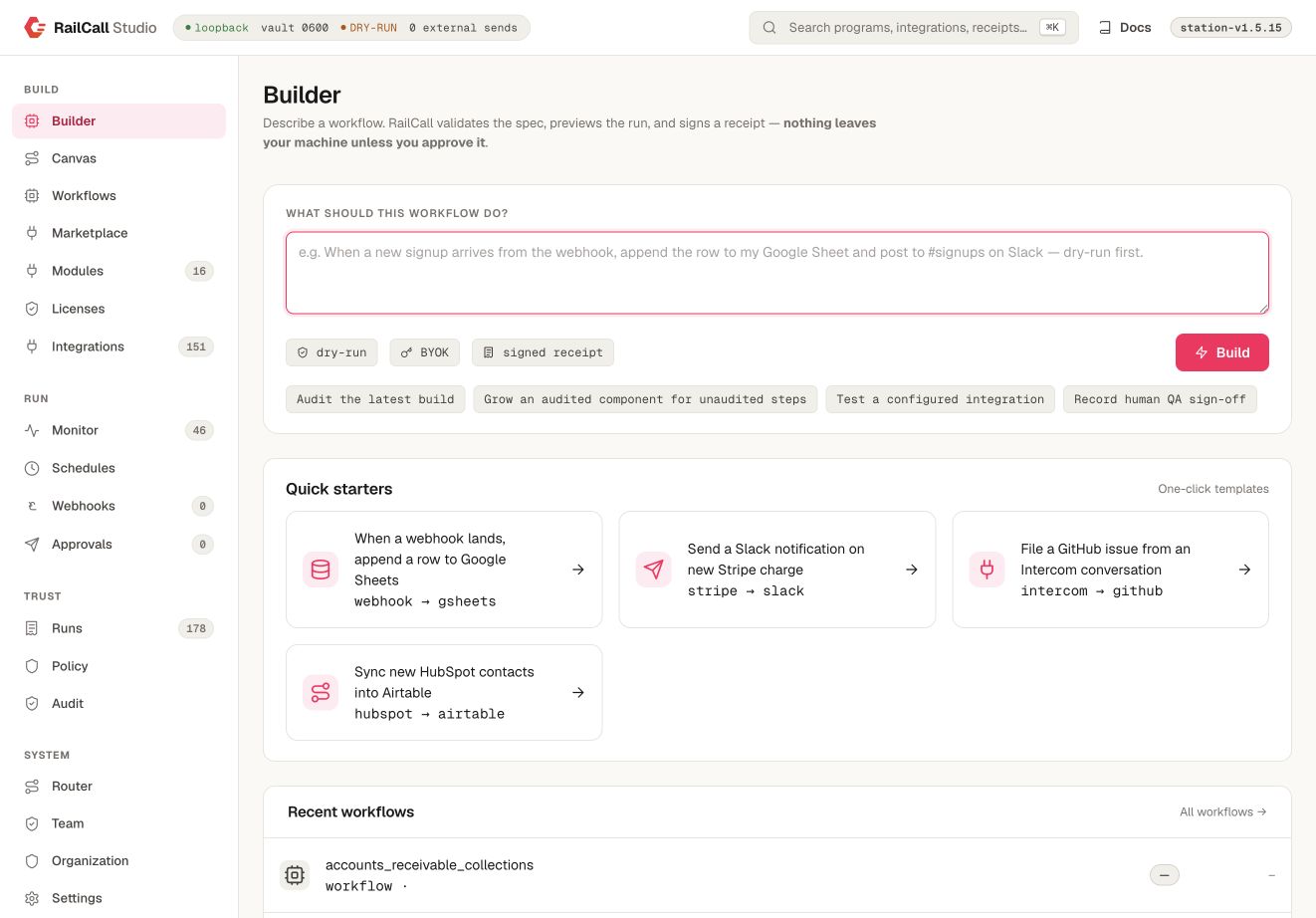
Open the control room to inspect workflows, configure steps, and review execution. Here’s what the product looks like.
Receipts are signed locally and can be verified offline. They establish the integrity of a recorded action, not the correctness of an AI answer.
Understand receiptsLocal models can keep reasoning on your machine. A shared host or cloud provider receives the requests you allow to use that route.
Read the privacy guideSTART LOCAL. CHOOSE WHERE TO GO NEXT.
Start with local models. Add an authorized collaborator’s machine or your own external model keys when the work calls for it.
Run supported models on hardware you own. Choose Auto to select among the routes you permit.
Explore modelsA capable teammate’s machine can serve a shared model. Access grants define who can use it.
Model sharingAllow external reasoning when you need it. Provider usage and data handling apply to that route.
Routing & permissionsExplore RailHub for team operations. Fleet routing is in early access; availability depends on the service.
DON’T START FROM A BLANK PAGE
Explore modules and workflows, or post a request for the piece you’re missing.
TWO PIECES. ONE LOCAL WORKSPACE.
Install Station, then connect the desktop app.
Free to start locally. Cloud providers and upgrades are optional.
Your local runtime for models, workflows, approvals, and receipts.
curl -fsSL https://railcall.ai/install.sh | bashThe desktop app for talking to your Station and turning requests into reusable work.
Download the desktop app Choose your operating system on the downloads page.Connect Chat to your StationA little help getting started? Join us on Discord